Fat loss isn’t meant to be fast if it’s meant to last!
You know the fact is that an astounding number of those of you who lose weight, or have lost a large amount of weight, will eventually put it back on and often, more.
Yes, it’s unfortunate and it also doesn’t need to be this way.
As coaches, we aspire to be the catalyst for change.
We choose to help people live their best lives. But sadly, we fail.
But did you know that for the majority of us, if you do go backwards, it really does make a difference to us. It actually does affect us. We actually feel like we have failed, and we do question our techniques and tactics. This is the honest truth. And if wasn’t the case then you probably would see through us. But you haven’t and we are here, in the now.
So let me encourage you a little further, if I may.
Your Fat Loss Journey
Your fat loss journey has just started (for many of you) and like anything meaningful in your life, there are times of growth and there are times of maintenance. But maintaining the habits you learn in the first place are crucial to your future success. For example, most of you know that to create wealth you need to make a little money, save a little money, spend less than you earn and keep practising this. It takes time. But when you do put a little away do you then go splurge day upon day, week upon week, month upon month. No! Because you would go broke.
The same goes for fat loss, your health and more importantly your well-being. We all have a metabolic rate to maintain, in order to do the things we love, as well as perform the way we want. So, we also have a budget of calories in which we get to spend, in order to nourish our body and fuel our minds. If we spend this by splurging day upon day, we will soon physically break in one way or another.
I encourage you to think about the important things in your life like this. Systematically. Like brushing your teeth and showering twice a day as a system to maintain your hygiene. It’s just a part of what you do!
This system allows you to achieve the things you want. It gives you freedom to do, act and be more. Systems allow us to produce results…Day in/ day out.
With finances most of us have a budget and this in turn helps us to be accountable. For if we overspend, we pay the consequence through credit applications or through having to go without in some way.
With nutrition we also need to account to our budget in order to be the people we want to be. To be gluttonous and over- eat regularly (and not move our bodies in a way to balance this out) is not how humans are meant to be. It’s not a system we can healthily accommodate without consequence.
But if we apply a system we do understand, then perhaps we can look at it through different lenses and simplify our approach.
Because for anything to last, it needs to be simple, meaningful and understood. It needs to be another system for you to upload and achieve a desired result.
And once you’re living the desired result, let me ask you a question… Would you move such a system to your trash folder? Would you wipe it from your hard drive?
No, I think not.
Make it happen
Coach D
Festive Season Nutrition Planning Doesn’t Need to be That hard!
These festive season nutrition tips will give you flexibility, while giving you good guidelines to use over this coming festive season.
Planning!
1. Moderation is the key with your festive season nutrition plan! Being too rigid in your thinking might swing you towards ‘all or nothing’ mentality. Instead swing towards most of the time I do and occasionally I may fall back here and there, but this will become less and less as you realise you don’t feel deprived when you follow your new program but actually feel rewarded by feeling fully energised every day! Fully capable of living your best life! That is a great place to be!
2. Plan what you have ahead of you and consider obstacles that may present over the holiday?
A) A break in routine disrupts what you usually do… prime time to lose focus and track?
B) Being away from home means you need to think ahead and do some shopping so you have access to some good food choices that are convenient when others may resort to junk options some of the time. You can opt to stay on track while being subtle and not disrupting your social activities.
Avoid making it a huge task but more a quiet consideration that will be there for you when you have opportunity. E.g. Raw almonds and fresh fruit, natural yoghurt in the fridge. These are great to fall back on instead of skipping a meal and then filling up on high fat and less than good nutritional choices, that are always everywhere at this time of the year.
3. Eat 3 meals during the festive season or replace a meal with two small snacks spaced apart, have a bit of what you feel like then fill up on veg and protein. Then ‘fast’ till your next meal. This will keep you on track a whole lot better and stop the kilos of fat piling on over the holiday. You can avoid the dread and feel great the whole season though.
Sugary Foods?
4. Be aware that if you do start eating more sugary and fatty foods than you have been your blood sugar and hunger hormones after a period of restriction will be wanting to push the accelerator. You need to avert this by drinking lots of pure water first and try eating pure protein before you eat anything of that nature. This will help minimise this effect. But also know it is ok to ignore impulse and distract yourself with other activities. Exercise balances out those sugar levels and cravings well. Once you increase your sugar intake again cutting back again is something that usually takes a day or so of cutting back to set it right again. So keep these points in mind when considering your approach and choices. The key is to be aware of your choices along the way. Avoid old routines!!
What about alcohol?
5. Alcohol usually features more at this time of the year and disrupts the festive season nutrition and fitness routine! If you are going to have some alcohol then avoid any snack foods, sugary foods and carbs. When you do have alcohol fill up on protein, salads and nutritious foods and you will find you will do just fine if you find a balance. This is a way of restricting the amount of calories you will take in, so desert/carbs/snacks included in a meal with lots of low calorie sparkling mineral water or a few glasses of wine with a lean roast and lots of healthy veg and salad choices. Tomorrow is another day and you can change it up.
6. Keep Moving! Your fitness has increased. You will find you want to move more so encourage the social aspect of being active (back yard cricket, walk along the beach, ride the bikes, swimming and activities that get everyone moving around at least 1-2hrs after a good meal. If you eat a lower amount of sugary and carb based foods you will also feel less lethargic than usual after eating not only too much but lots of sugar, fat and concentrated foods together
7. Separate high fat and high carb foods. E.g. Hommus dip or homemade avocado dip with veggie based option (carrot sticks, celery, cucumber sticks etc.). To dip… Rather than chips and dip or oily crackers choose low fat but quality and still nice crackers. Try choosing whole meal and seeded options that are less processed.
8. Shopping selections: Dips – bought dips are often nearly all processed fats!! Read ingredients and choose those that are vegetable/tomato/chickpea based and have the least oil on the list of ingredients. Dip is so easy to make and so much nicer than the bought stuff. It also costs a fraction of the price! You can make the stuff in the kitchen while all the action and social activities go on. It is impressive to make and present some great tasting dips that are also nutritious for people to try! Add veggie sticks and Rye bread and Dukkah with some balsamic and a dash of quality extra virgin olive oil. Explore the options.
9. Think about quality over quantity – select a bit of what you’re really feel like, take some time to consider, there is no rush in the holidays so take time to enjoy and savour the things you do enjoy. Encourage others to join you and take some time.
10. Include some intermittent fasting! I love this idea around festive season nutrition and think it could be employed 1-2 times per week annually.
Use the following morning to complete an intermittent fast and drink 1-2L pure filtered water. You can simply sip on a B.C.A.A drink or eat some pure scrambled egg whites which are pure protein without any carbs.
By having some protein this will supply the muscles with amino’s but encourage your body to burn energy stored in glycogen from the day before when you ate more calories. This will help prevent you from storing up body fat but do make sure you then eat a healthy meal when you break your fast so that your body does have access to good protein and some complex carbs as well as some good essential fats. E.g. Lean chicken salad with avocado, spinach and boiled cooled chopped sweet potato rolled in a drop of olive oil and balsamic dressed with cracked pepper and rock salt.
11. Don’t set out to party on an empty stomach. Always eat either a meal or snack of protein, veggies and some essential fats before heading out. This will help stabilise your blood sugar and prevent you from overeating and giving in when you know it’s not the best for your goals long term.
12. If you feel you have ‘fallen off the wagon’ at any point don’t delay, avoid or let guilt delay getting back on track. Accept it and just go back to what you know makes you feel better. Sometimes it’s just about starting, just do it! Procrastination is seldomly anyone’s friend.
My last tip for your festive season nutrition plan is to try juicing. Similiar to intermittent fasting or to work in conjunction with this. try juicing for breakfast and eating only between 12-8. This is a simple and very effective method for weight management.
I hope this helps your festive season nutrition plan and as always if you need some help just ask dion@vivafitness.com.au
Make it happen
Dion
10 Lifelong Tips For Healthy Lean Bodies
1. Eat every 2-3 hours.
Are you doing this – no matter what? Now, you don’t need to eat a full meal every 2-3 hours but you do need to eat 6-8 meals and snacks that conform to the other rules below.
2. Eat complete, lean protein each time you eat.
Are you eating something that was an animal or comes from an animal – every time you feed yourself? If not, make the change. Note: If you’re a vegetarian, this rule still applies – you need complete protein and need to find non-animal
sources.
3. Eat vegetables every time you eat.
That’s right, in addition to a complete, lean protein source, you need to eat some vegetables every time you eat (every 2-3 hours, right?). You can toss in a piece of fruit here and there as well. But don’t skip the veggies.
4. Eat carbs only when you deserve to.
Well, not ALL carbs – eat fruits and veggies whenever you want. And if want to eat a carbohydrate that’s not a fruit or a vegetable (this includes things like simple sugars, rice, pasta, potatoes, bread, etc), you can – but you’ll need to save it until after you’ve exercised. Yes, these often heavily processed grains are dietary staples in North America, but heart disease, diabetes and cancer are medical staples – and there’s a relationship between the two! To stop heading
down the heart disease highway, reward yourself for a good workout with a good carbohydrate meal right after (your body best tolerates these carbohydrates after exercise). For the rest of the day, eat your lean protein and a delicious selection of fruits and veggies.
5. Learn to love healthy fats.
There are 3 types of fat – saturated, monounsaturated, and polyunsaturated. Forget about that old “eating fat makes you fat” maxim. Eating all three kinds of fat in a healthy balance (about equal parts of each) can dramatically improve your health, and even help you lose fat. Your saturated fat should come from
your animal products and you can even toss in some butter or coconut oil for cooking. Your monounsaturated fat should come from mixed nuts, olives, and olive oil. And your polyunsaturated fat should from flaxseed oil, fish oil, and mixed nuts.
6. Ditch the calorie containing drinks (including fruit juice).
In fact, all of your drinks should come from non-calorie containing beverages.
Fruit juice, alcoholic drinks, and sodas – these are all to be removed from your
daily fare. Your best choices are water and green tea.
7. Focus on whole foods.
Most of your dietary intake should come from whole foods. There are a few times where supplement drinks and shakes are useful. But most of the time, you’ll do best with whole, largely unprocessed foods.
8. Have 10% foods.
I know you cringed at a few of the rules above. But here’s the thing: 100% nutritional discipline is never required for optimal progress. The difference, in results, between 90% adherence to your nutrition program and 100% adherence is negligible. So you can allow yourself “10% foods” – foods that break rules, but
which you’ll allow yourself to eat (or drink, if it’s a beverage) 10% of the time.
Just make sure you do the math and determine what 10% of the time really means. For example, if you’re eating 6 meals per day for 7 days of the week –that’s 42 meals. 10% of 42 is about 4. Therefore you’re allowed to “break the rules” on about 4 meals each week.
9. Develop food preparation strategies.
The hardest part about eating well is making sure you can follow the 8 rules above consistently. And this is where preparation comes in. You might know what to eat, but if isn’t available, you’ll blow it when it’s time for a meal.
10. Balance daily food choices with healthy variety.
Let’s face it, when you’re busy during the week, you’re not going to be spending a ton of time whipping up gourmet meals. During these times you’re going to need a set of tasty, easy to make foods that you can eat day in and day out.
However, once every day or a few times a week, you need to eat something different, something unique and tasty to stave off boredom and stagnation.
What about everything else?
So what about caloric intake, or macronutrient ratios, or all the other technical and theoretical issues that are often debated? According to DR John Berardi from Precision Nutrition he believes that “those other things only become relevant once you’re practicing the above-mentioned habits, and by practicing them I mean putting them to use over 90% of the time (i.e., no more than 4 meals out of an average 42 meals per week violate any of those rules).
Moreover, most people can achieve the health and the body composition they desire just by following those ten rules alone. No kidding! In fact, with some clients I’ve spent months just supervising their adherence to those rules. That’s an effective but costly way to learn them.” Says Dr John.
So You Want to Improve Posture, Right? Lets’ deepdive on ‘Strengthen and Lengthen’
Jordan Peterson, professor of psychology at the University of Toronto, made the first rule in his book 12 Rules For Life: “stand up straight with your shoulders back”. In this chapter he touches on more than the fact that good posture is aesthetically pleasing; he discusses how, when we adopt good posture, we are perceived by ourselves and others as more confident, dominant and worthy of respect. Did you know that when you improve posture you will even change your physiology, increasing the release of serotonin, which literally makes us more confident and more likely to feel positive emotion – rather than just looking it? This is why adopting a powerful pose has been shown to increase test performances in a variety of different situations.
Unlike many other things in your life that you may have no control over, your posture is completely decided by the way you spend your time – and genetics. Therefore, if you’re looking to improve an element of your life, start by improving your posture. Unfortunately, the age we live in has caused many of us to develop routines that draw our body into unfavourable positions; our heads and shoulders get pulled forward, our shoulders round inwards and our spines are excessively arched. Fortunately, there is something you can do about this, which is where I come in. This article is going to teach you the foundations for what drives our poor posture, as well as the corrections to develop a better posture.
To start improving our posture we need to do two key things:
1. Lengthen the muscles that are drawing you into a bad posture
2. Strengthen the muscles that hold you in a good posture.
Study the image on the following page (refer to figure 1); I have highlighted the muscles that you will need to lengthen in blue, and the muscles you will need to strengthen in green.
Notice the interesting dichotomy, if you are familiar with the Joint-by-Joint theory you may have picked up on the trend. The need to lengthen vs strengthen alternates predictably from one joint to the next. For example, from the back view of our body we see that the neck needs lengthening, the shoulders need strengthening, the torso needs lengthening, and so on and so forth.
Also, the muscles on the front side of the body at one joint, require the opposite action to the muscles on the back side of the body at that same joint. For example, at the hip joint we need to lengthen our hip flexors on the front side of the body, and strengthen our major hip extensor (glutes) on the back side of our body.
After studying the image, continue down the pages to see an example movement you can do to strengthen and lengthen each joint to improve your posture. The exercises provided are only one of many that could be done, feel free to choose your own if you have other preferred movements but, be careful not to change the muscle groups being worked. For example, at the shoulders I suggested the Y-W-T-A as the movement of choice as this targets the back extensors, shoulder retractors and external rotators of this joint. An exercise that seems like a reasonable alternative would be a Lat Pull Down, as this targets a very similar area. But notice, a Lat Pull Down will predominantly target the lats and biceps, both of which have been highlighted as muscles that need to be released, not strengthened thus you must be careful in your choices of modification.
Disclaimer: technically the hamstrings are a hip extensor, however their origin serves as an unfavourable mechanism of action due to the torque forces they can put on the lower back, thus we would be better suited to target the glutes for strengthening and the hamstrings for lengthening.
Figure 1 Postural Muscles (Edited image sourced from Britannica: https://www.britannica.com/science/human-body)
The body
Blue = Lengthen Green = Strengthen
NeckMost people have tightness in the back of their neck, which raises their chin and gives them that forward head posture. We must then, stretch the back of our neck and work on movements that will pull our chin down and back. Note: excessive neck strengthening is often less valuable than neck lengthening, prioritise the chin tuck stretch here.
Figure 2 Chin Tuck (Image Courtesy of Life of PT: https://www.lifeofpt.com/chin-tuck-exercise-when-and-how-to-perform-it/)
Figure 3 Neck Stretch (Image Courtesy of Information PVT: https://www.informationpvt.com/2019/02/neck-stretching-tips.html)
Shoulders Most people have tight pecks and weak backs which draws their shoulders forward, to correct this we must lengthen our pecks and activate our upper back and external rotators of the shoulder girdle. Check the link under “Y-W-T-A” to learn this movement in greater detail.
Figure 5 Peck Stretch (Image Courtesy of Pinterest:https://www.pinterest.com.au/pin/364087951118101245/?autologin=true )
Trunk
Excessive curvature of the lower back and tightness through our lats cause what is known as the duck posture, as well as inwardly rotated shoulders that make us look like gorillas. Stretching the lats will help bring the arms back to a better position while turning on the core will align the spine in a more neutral posture. Check the link under “Posterior tilt/Marching” to see how to correctly train your core for posture.
Lengthen by: Lat Stretch Strengthen by: Posterior tilt/Marching
Figure 6 Lat Stretch (Image Courtesy of BodBot: http://www.bodbot.com/Exercises/772/One_arm-Lat-Stretch)
Figure 7 Hip Flexor Stretch (Image Courtesy of Pinterest: https://www.pinterest.com.au/pin/235453886742407564/)
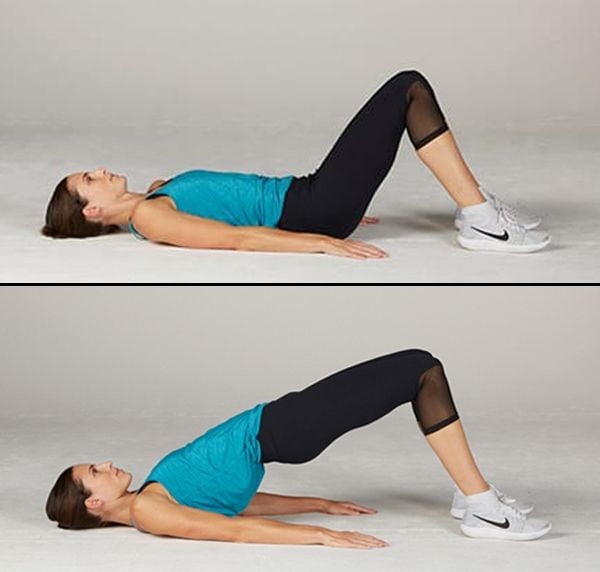
Hips The following are probably the highest yielding movements out of this whole article. Most people have tight hip flexors that need lengthening and underactive glutes that need activating. Check the link under “Glute Bridge” to learn extra tips for performing the exercise.
Lengthen by: Hip Flexor Stretch Strengthen by: Glute Bridge
Figure 8 Glute Bridge (Image Courtesy of Pinteresthttps://www.pinterest.com.au/pin/243335186103197918/)
Figure 9 Hip Flexor Stretch (Image Courtesy of Row Perfect https://www.rowperfect.co.uk/stretching-hip-flexors-for-rowing/)
Thighs
The thighs are of lower importance when it comes to posture, these movements therefore are certainly lower yielding compared to the others mentioned in this article, but those looking for an extra couple percentage points of improvement, these are for you.
Figure 10 Hamstring Stretch (Image Courtesy of Pop Sugar https://media1.popsugar-assets.com/files/thumbor/V79mWjf6Xjup28tDXPGzoWBUVcU/fit-in/1024×1024/filters:format_auto-!!-:strip_icc-!!-/2013/03/12/2/192/1922729/2a8d7475eae1d6a3_propped-up-hamstring-stretch/i/Advanced-Standing-Hamstring-Stretch.jpg)
Figure 11 Standing Knee Extension (Image Courtesy of Power School Learninghttps://misshalls.learning.powerschool.com/cmcanespie/athletictraining1/cms_page/view/34357009)
There it is, the way to improve your posture; the way to make yourself look better, be perceived better and ultimately feel better. Try out the suggested movements, incorporate them into your daily or weekly schedules and see your posture, and thus the rest of your life, improve.
We Make It Happen and Change Lives
Team Viva!
Covid-19 and Your Fitness- “Staying sane in an insane world”
“Is it just me, or is it getting crazier out there?” Quite a fitting line from Arthur Fleck aka “The Joker”, and this appiles to covid-19 and your fitness!
Arthur was found saying this only months before physical fights were breaking out in supermarkets over packets of toiler paper. The Joker is one of my favourite movies of all time, it blends two of my greatest interests together: stories and psychology. It shows the descent of the human mind through episodes of psychosis and leaves the viewer questioning what is real and what isn’t. It shows what a chaotic society combined with an unstable mind can result in. In many ways it parallels the situation we encounter today; there is mass hysteria in the news and individuals are left in complete uncertainty as to their physical, financial and psychological security. To take another line from The Joker, “It is enough to make anyone crazy”. What we are left with is a world where it is scary, and even illegal, to continue on with our regular routine. The question arises: what can we do to survive in such a state of chaos. In this post, I will shed my thoughts on one way in which you can deal with such a situation: The Schedule.
Schedules are a powerful tool and should never be overlooked. A schedule brings order out of chaos. It is one of the easiest things you can actually develop that will instantly bring clarity to your life, while improving your covid-19 and your fitness program. I use a schedule religiously. Some people need more plans than others, and that is fine if you are one who wants less rigidity in your day, but for me, I like to know exactly what I am doing. Here is a thought process that never works: “I am going to be productive today”. Okay great, first of all what does that even mean? And second of all, how the hell, after defining what it means, are you going to meet those requirements for productivity? The likely answers are, you don’t know and you aren’t going to. A schedule helps you to design your life in a way such that you can be productive and you know you are being productive because you have set tasks that you want to accomplish and you work towards achieving them. Here are some tips I suggest for making your schedule.
Understand the two-key components: your schedule should be a healthy balance of purposeful activity and self-care. A purposeful activity is a goal-directed use of time. You might have a goal of going to sleep in a clean house, therefore undertake the purposeful activity of cleaning. You might have the goal of having your reports completed and thus undertake the purposeful activity of writing. Self-care is any type of activity that you do to maintain your own physical and psychological health. It might be exercise, reading, eating healthy, relaxing at night, or any other number of things that you enjoy and make you feel good. Consider the specific type of these activities you need and want in your day when writing your schedule.
Design the day you want: do not try to tyrannize yourself, it won’t work and if it does, you’ll resent yourself for it and not be willing to do it again. Bargain with yourself and decide what is the right amount of work to be met with the right amount of reward. In The Shining, Jack writes a book that is the line “All Work And No Play Makes Jack A Dull Boy” over and over again (a moment sadly missed in the book). Do not try and be like Jack, balance purposeful activity with self-care.
Remember to login to access. Here are some steps to start you today.
Start small: If you have taken this time as a bit of a break from reality, then do not try and jump back into a routine that would make Elon Musk look like an unemployed teenager. Here is a good rule: schedule what you would do, not what you could do. I am sure if a gun were pressed to your head, you could exercise for two hours today, then read 100 pages from War and Peace followed by meal prepping for the rest of the week. But, without such persuasive techniques encouraging you, it might be more difficult to do all of that out of nowhere. Start with something, anything, you would be proud you did today and reward yourself for it. That way tomorrow, you will be more likely to do it again.
Sleep: One of the first things most psychologist do in treating mood disorders is look at the patients sleep wake schedule. Is the person going to bed and waking up at the same time every morning? Or, are they all over the shop, going to bed and waking up at all times? The time you wake up and the time you go to bed strongly influence your hormonal balances throughout the day. An unsteady sleep-wake pattern leads to an unsteady hormonal balance and ultimately leads to fluctuations in mood, energy and cravings, to name a few. If you can only do one, pick to wake up at the same time every morning. Allow yourself half an hour on either side maximum per week and you will be far better of for it.
There has it, the importance of a schedule and four tips for your creation of one. Consider what I’ve written here and try to implement the strategies into your own daily planning and kick some goals through covid-19 and your fitness plan. You will find that having a clearer structure to your day will help to keep you on track, and keep you sane, in this insane world.
Coach Jay
Did you know Fish Oils help you build muscle and lose fat?
Fish oils help the body in so many ways! Fish oils, Aka ‘Omega 3 fatty acids’, are super important because they will improve the health of every cell in your body!
The problem is that most people have a higher omega 6 to omega 3 ratio, which causes inflammation in the body. Thus preventing you from losing weight, as your body is off fighting other battles. The more packaged foods you eat, along with eating out, cooking with omega 6 oils like any veggie oil (try using only coconut oil, grass fed butter or nut oil. Even olive oil burns fast, changing its health property’s. It’s only best consumed raw) has most of the population consuming 20-30 times the amount of Omega 6 to Omega 3’s. The body runs optimally at a low 3-1!
This is why supplementing with high dosage fish oil will help decrease inflammation and help your body lose fat.
Fish oil will also help build muscle and a recent study showed that those taking 4 g of fish oil, compared to another group taking the same dose of safflower oil (which is an Omega 6), lost body fat and increased their muscle mass. What was interesting is that those in the study, who took fish oil, had a large decrease in the stress hormone cortisol. Cortisol is a catabolic hormone that degrades muscle, which leads to fat gain and this is because it slows down the metabolism and makes you feel stressed out.
What it all comes down to is that fish oils help in many ways and will convey these anti-inflammatory benefits
1- Detoxification of the stuff you don’t want in your body, like waste products and Inflammatory biomarkers
2- Improve cellular health and building of muscle
3- Decrease hormones that cause inflammation, and
4- Help you live and feel better
There is an additional supplement that aids in fat loss when accompanied to fish oil, which is is carnitine.
Research to date has shown that combining Carnitine & Omega 3 can be beneficial to your health. Taking Omega 3 has been shown to improve the efficiency at which Carnitine can work. By taking both together cells are better able to absorb fatty acids to burn for energy. This can help speed up the body’s metabolic rate and therefore helps with fat loss. Although Omega 3 has been shown to improve the efficiency of Carnitine it is not essential for it to work.
We currently stock ‘practitioner only’ goods that are tried and tested ensuring the best quality, of both fish oil and carnitine. Contact kristy@vivafitness.com.au to look at what supplements may help you.
I’d love for you to check out more healthy eating tips here and hope it helps https://vivafitness.com.au/lean-body-eating/
Make It Happen
Dion Mychalyn
Calorie Counting and our Fat Loss Food Cheat Sheet Will Certainly Help Your Summer Body
But and it’s a big but, Using our fat loss food cheat sheet to count calories is not necessary to be lean and for most people just trying to shape up, calorie counting is just not necessary!
However, I know people will count anyway so we have created this. One important subject however is ‘portion size’ and what substantiates a portion of protein, carbohydrates and fat. So this food cheat sheet can be used to look at what a ‘portion’ should consist of.
I.e. For most people a good breakfast will have around 25-50 grams of protein (3-5 eggs), 15-30 grams of fat (add a few walnuts to add fat if need) and a good fibrous low starch carbohydrate like mushrooms and spinach with your omelette (BTW, that’s my signature move 4 days a week). On this, a high-protein and high-fat breakfast will stimulate all those feel good neurotransmitters Aka. ‘Dopamine’ to get you energised for your morning. This will lead to more clarity and has a satiating affect leaving you fuller for longer. Log in to our ‘sister site and check this out http://ultimatebodyblitz.com.au/why-go-a-high-fat-breaky-introducing-the-meat-and-nut-breakfast/
Using the three tables below you can pick a protein, carbohydrate and fat to suit your needs.
Food Cheat Sheet Calorie Counter
Here is a very well know formula to know how many calories to eat. Yes I know, I mentioned you don’t need to count but you still need to know what portions to have.
So to use the food cheat sheet we need to know what portion size you require!
Your weight x 2.2 to make it in pounds. I.e. 80k x 2.2 = 176
We then ‘X Multiply’ by
10-14 for weight loss
14-16 maintenance/ muscle gain
17+ for growth.
I.e. 80 kilo female wanting to lose 5 kilos we would start at the higher amount for one week and schedule exercise and see what takes shape. So ‘X’ 14= 2464
We will go on a fat loss scheme of:
40% protein (no more than 3 grams per kilo) – 240 grams of protein
40% fat- 109 grams
20% carbohydrates- 120
These are approximates and now know how many grams to eat in each meal.
Do not consume fat in your post workout meal and consume a minimum of 50% of your carbohydrates in this meal and then the remainder in the next meal.
Meal Distribution Example
I.e. train at 530pm.
Meal 1, 2, 3- 730am, 1130 am, 330pm
48 g protein, 25 g fat and less than 10g of carbohydrates made up of veggies
Meal 4 post training shake- 7pm
48 g protein, 50 g carbohydrate
Meal 5- 2 hours prior to bed
48 g protein, 50 g carbohydrate and veggies.
Now this will allow you to relax as carbohydrate is great for the nervous system to recover and relaxes us, which is why we don’t want it prior to workouts.
In fact fat loss food is quite the opposite… Flavour is the key to delicious wholesome cooking.
You see most people lack flavour in their cooking and substitute with sugar, poor choices of fat (not the best options like those containing omega 6’s I.e frying ouil etc) and excess salt.
Now, most foods can be dressed up into flavoursome meals by adding herbs, spices, salsa’s, dressings etc. This is how we can turn quick easy barbecue’s, pan fried and grilled meats into delicious meals. In turn, this will reduce excess calories, as well as, foods that create inflammation and therefore illness.
Fat Loss Foods and Probiotics
Probiotic foods are great, but prebiotic foods might be even better at improving your gut health and all the other benefits that come with it.
“Prebiotics can be thought of as the food for probiotics,” says Melissa Majumdar, R.D., a senior bariatric dietitian at Brigham and Women’s Center for Metabolic and Bariatric Surgery in Boston, MA.
Prebiotics differ from probiotics in that they’re not living microorganisms—they’re fermentable fibers that pass through your digestive system undigested then promote probiotic growth and activity. “Pre- means ‘before’ and signals that prebiotics are a prerequisite for bacteria,” she says. “Pro- means ‘for life,’ which suggests probiotics are live, active bacterial cultures.”
So today I have added for you my ‘fat loss food’ cheatsheet. This can be used to make awesome grilled and barbecue meats etc.
Now I love to cook but this cheat sheet is not mine. Instead it has been used by me to make many wonderful meals and I owe it all to my good friend, client and our local chef, Eloise Jury, AKA ‘Kitchen Macgyver’.
She is an amazing woman, mum and chef.
Thankyou for making me rock El!
Enjoy guys and make it happen!
Dion Mychalyn
So You Want To Learn More About Bodyweight Exercise?
Bodyweight exercise is a great fitness tool to add to your toolbox as it needs little space and uses your body to move in a way in which it’s designed.
Primal movements such as roll, sit, crawl, walk, squat to stand and so on are honestly forgotten by most adults in todays world. Never before have we had so many tools to allow us to avoid basic movement. With cars, buses, trains and desks occupying many minutes of our daily routine, the basics of primal movement is simply no longer required.
But what if it is? What if I were to say to you that by simply getting to the floor and rolling around a little more often you could offset many of todays common injuries like back pain? You see many people are stiff and sore, not from working too hard but by moving too little. And when they do move it’s generally not well! So the body then compensates with a poor movement pattern and this can lead to injury. Another example of a vicious cycle, right?
How to use bodyweight exercise?
Well I am not saying that this is the wonder movement to fix all, but I am saying that we can add such movements into our day as a morning 5 minute stretch to prepare your body for the day.
This can also be used as:
A High intense warm up
A finisher to your training day. Try 30 on 30 off intervals of each exercise
A Recovery Day
A full body home workout or when travelling
Check out the vieos below where we have broken each exercises day as well as shown a version of using these as an interval. This had stav working well above 70% heart rate giving here a training effect.
I look forward to hearing your comments @ dion@vivafitness.com.au
Make it happen!
Animal Flow Beast
Everyone has food cravings for certain foods, So let’s look at some healthy choices
Everyone has food cravings and slip-ups, but it is not the end of the world! So, why do we crave certain foods and why do we give in to the temptation?
Firstly we need to realise whether we are really hungry or whether it is just a craving? There is a difference between hunger and cravings.
Hunger is a biological need to eat something because your stomach is empty, and therefore as research has shown, we tend to want to eat protein foods to satisfy their hunger. A craving, however, is an intense desire for a specific food. The main reasons why we crave specific fatty and high carb foods, are stress, anxiety, depression and fatigue. It is hard to resist cravings with so much food readily available. And yes it is ok to indulge occasionally but there are healthier alternatives that have fair less guilt attached.
One of the most vital steps in succeeding is to plan ahead. For example, if you are going to a function in the evening and are going to be faced with specific food, you have the following choices;
learn to hold back and say no
change your food plan for that specific day leading up to the function, and allow yourself freedom
or have a healthier alternative!
Do nothing… (the first 3 are much better 🙂
Do not beat yourself up about cravings because it can lead to you feeling worse and eating even more. Use it as a learning tool to notice what happened and what you can do next time, to prevent the situation from arising. We all go through a stage when we crave foods such as chocolate, or ice-cream, and of course it is important not to give in every time.
What do you do?? Everybody needs to satisfy their cravings once in a while, and therefore you should be prepared with a substitute.
Food Cravings Substitutes:
Examples of substitutes: Ice-cream = Non-fat frozen yoghurt Cola = Flavoured Carbonated water Sugar coated cereal = Whole grain cereal, Oatmeal with fruit Potato Chips = Low fat chips, Popcorn, dry pretzels, Veggie chips, Rice Crackers Sundae topping = Fresh berries/banana, Diet chocolate and
strawberry toppings Whipped cream = Non-fat milk whipped with a hand blender Cake = Low fat banana or zucchini bread Take-away = Home-made burgers, pita pizza’s use an air fryer Salty Nuts = Raw Nuts baked in oven and salted yourself Chocolate = Carob, Nutella, dark chocolate sucked in roof of mouth Lollies = hight fat and protein snack like a shake or a tin of tuna to curb the sugar focus! White bread = Lavash Breads, Whole Grain sourdough
If you are going out for the night and there is going to be alcohol and high sugar fatty foods, it is OK to indulge on these odd occasions. Here’s a quick recap of what we have discussed;
The best thing to do is to simply plan ahead.
Stick to your set eating plans during the week, but slightly alter it on the day when you are going out.
Eat less or no carbs during the day, and if possible, miss out on your afternoon snack to substitute.
Another important step to take is to undertake some high intensity exercise before the event.
If you do happen to slip-up and are unable to plan ahead, do not believe it is too difficult to get back on track. Once again, the most important thing is not to get annoyed with yourself, but instead just alter your few meal.
Learn from the process and find something that works.